Website Case Study
Time Change Canada
An independent guide to Canada's 2026 clock changes that tells visitors, for their own town, whether the clocks change on November 1 and what that means for the times they rely on.
At a Glance
Time Change Canada is our own independent guide to the 2026 clock changes. On Sunday, November 1, 2026, B.C., Alberta and Manitoba stay put while most of Ontario, Quebec and the U.S. fall back an hour, and the site tells visitors in seconds which applies to their town and what changes for everything else. A map of the world's time zones, a finder covering about 56,000 towns, a time difference tool, a live clock board and a province-by-province summary with official sources share one page. We built and launched it in October 2026.
- Project
- Website
- Sector
- Public information
- Scope
- One-page guide with an interactive map and time tools
- Highlights
- Town finder, time difference tool, clock board
- Live site
- TimeChange.ca
The Brief
When some provinces stop changing their clocks and others do not, the simplest question becomes hard to answer: does my clock change this weekend? The site had to answer it for anyone in seconds, then make everything that follows from it easy to understand.
- Answer the question for the visitor's own town first, with a quick way to check any other town.
- Show on one map where clocks stay put, where they fall back and where they change on another date.
- Make time differences easy to work out on any day, counting clock changes at both ends.
- Set out the rules province by province, with a link to the official source for each.
What We Designed
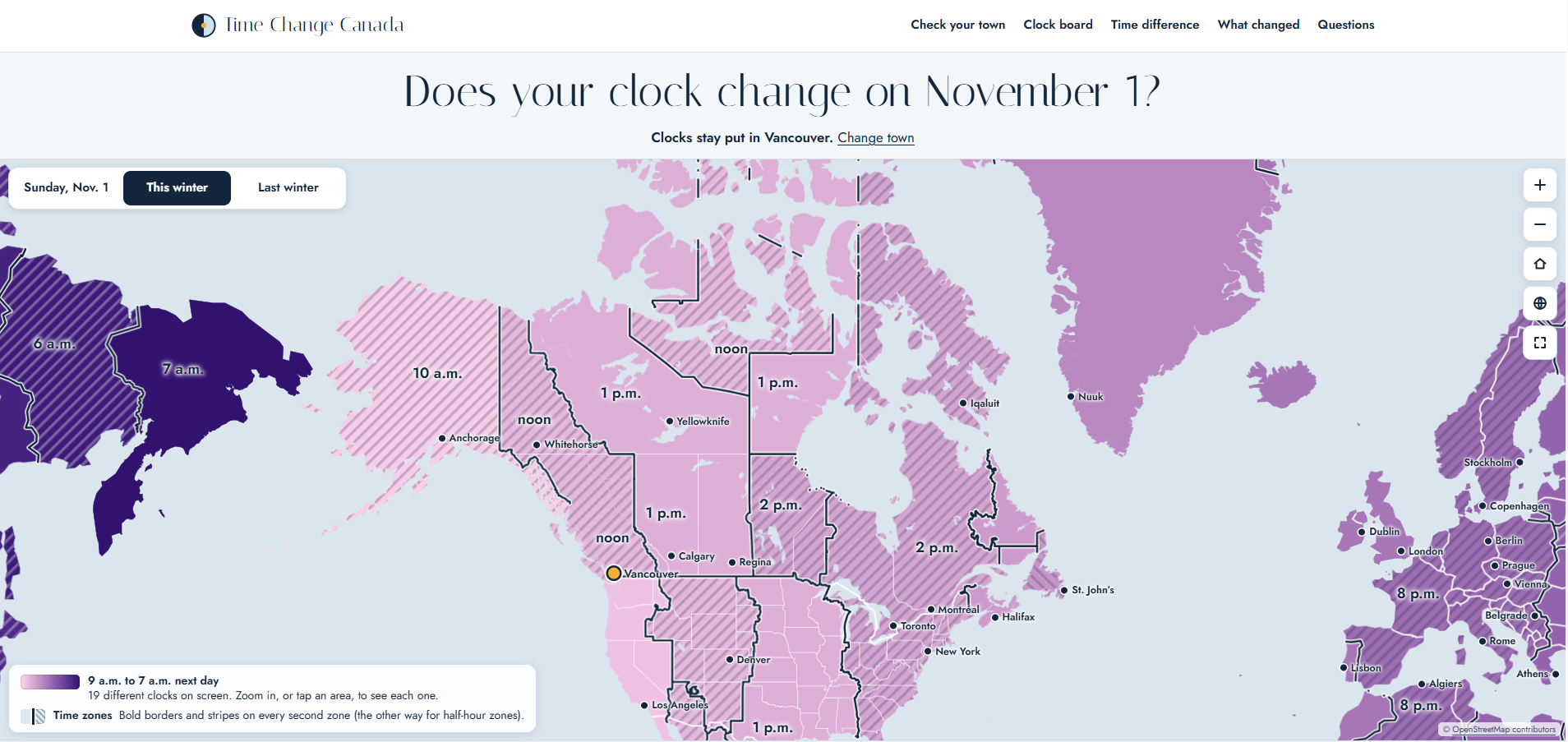
The page opens with the question itself, set large in Italiana, a slender display serif, and the answer for the visitor's own town directly beneath it. Below sits an interactive map of the world's time zones with three views: Sunday, November 1, coloured by where clocks stay put and where they fall back; this winter, shaded by local time; and last winter, for comparison. Bold borders and stripes on alternating zones keep neighbouring zones distinct, and zooming in reveals the local exceptions, from the Kootenays and Creston to Lloydminster and Point Roberts.
Colour carries the meaning throughout: blue for places that stay put and orange for places that fall back, on the map, in the clock board and in the province-by-province columns. Jost, a clean geometric sans, sets the body text and every number, even the digits inside the Italiana headlines, so times and dates always read clearly. Everything else stays calm, deep navy type on a pale blue-grey page, so the map and the answers stand out.
Town finder
About 56,000 towns, including every Canadian town of 1,000 people or more, each with its answer, the time now and its winter and summer gaps.
Time difference tool
Ask in plain words what time it is in another town on any day, with an hour-by-hour strip and a link you can copy to share the answer.
Clock board
Live times across North America, grouped into places that stay put and places that fall back, with each one's gap from your town this winter.
Province by province
What changed in each province and territory, and in local exceptions such as the East Kootenay, with a link to the official source for each rule.
How We Achieved It
Every time on the page is calculated from the rules each province, territory and state has announced, not read from the visitor's device, with dates running to the end of 2032. Because phones and computers take their rules from a shared world time zone database, a section on whether your phone will get it right checks the browser in use and reminds visitors that clocks on stoves, cars and older gadgets won't update themselves.
For search, the page title asks the question people are typing, and nine common questions are answered in plain language and marked up as an FAQ for search engines. The official sources, from the Province of B.C. to the IANA Time Zone Database, are listed at the foot of the page with the date the rules were last checked. Because the rules are still changing, visitors can sign up for one short email when a province, territory or the U.S. changes its clocks, and a short form asks them to report a missing town or a mistake.
Keep Exploring
More Case Studies
Want a Website Like This?
Let's talk about what your business needs, or start with a custom five-page website for $49 US a month.